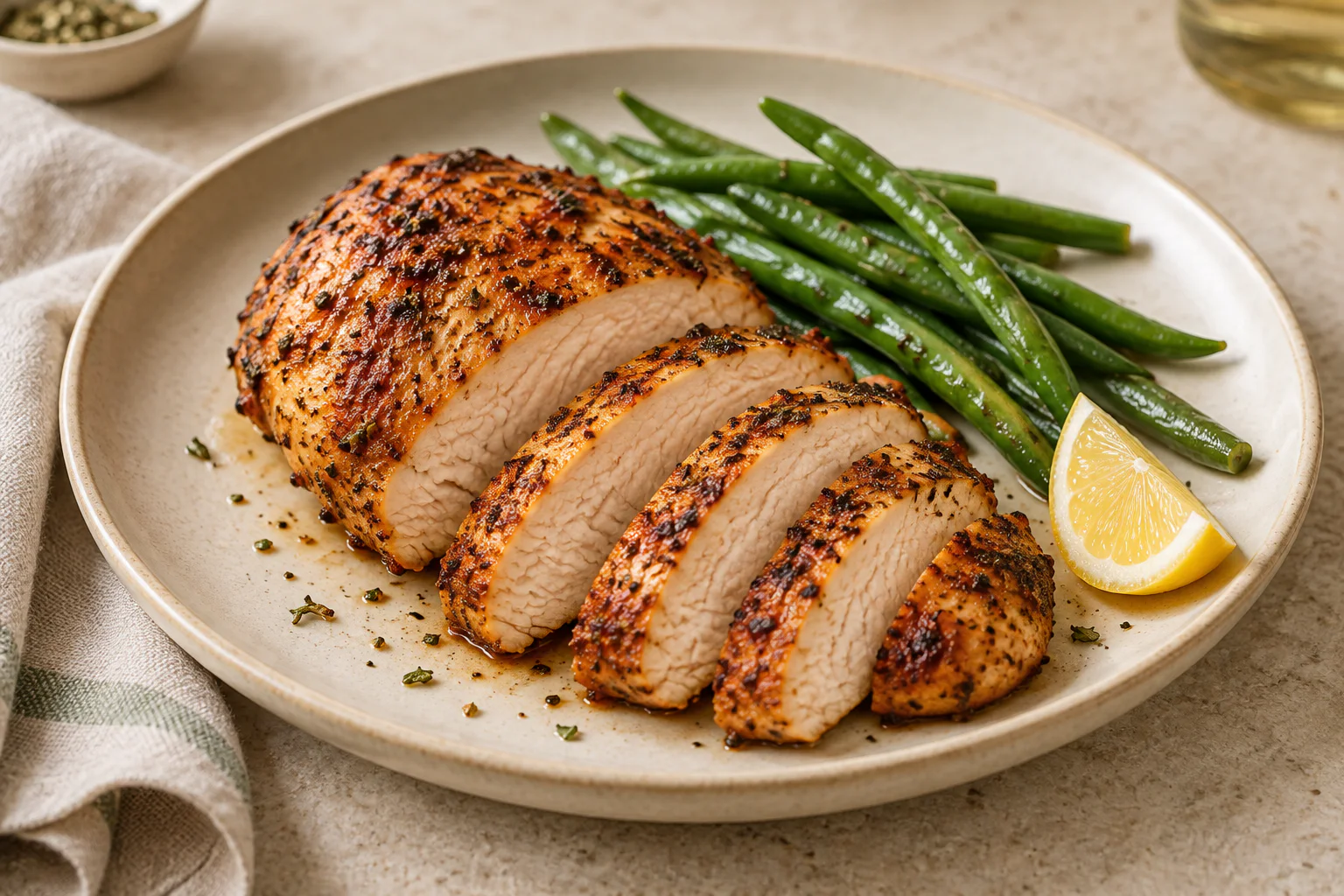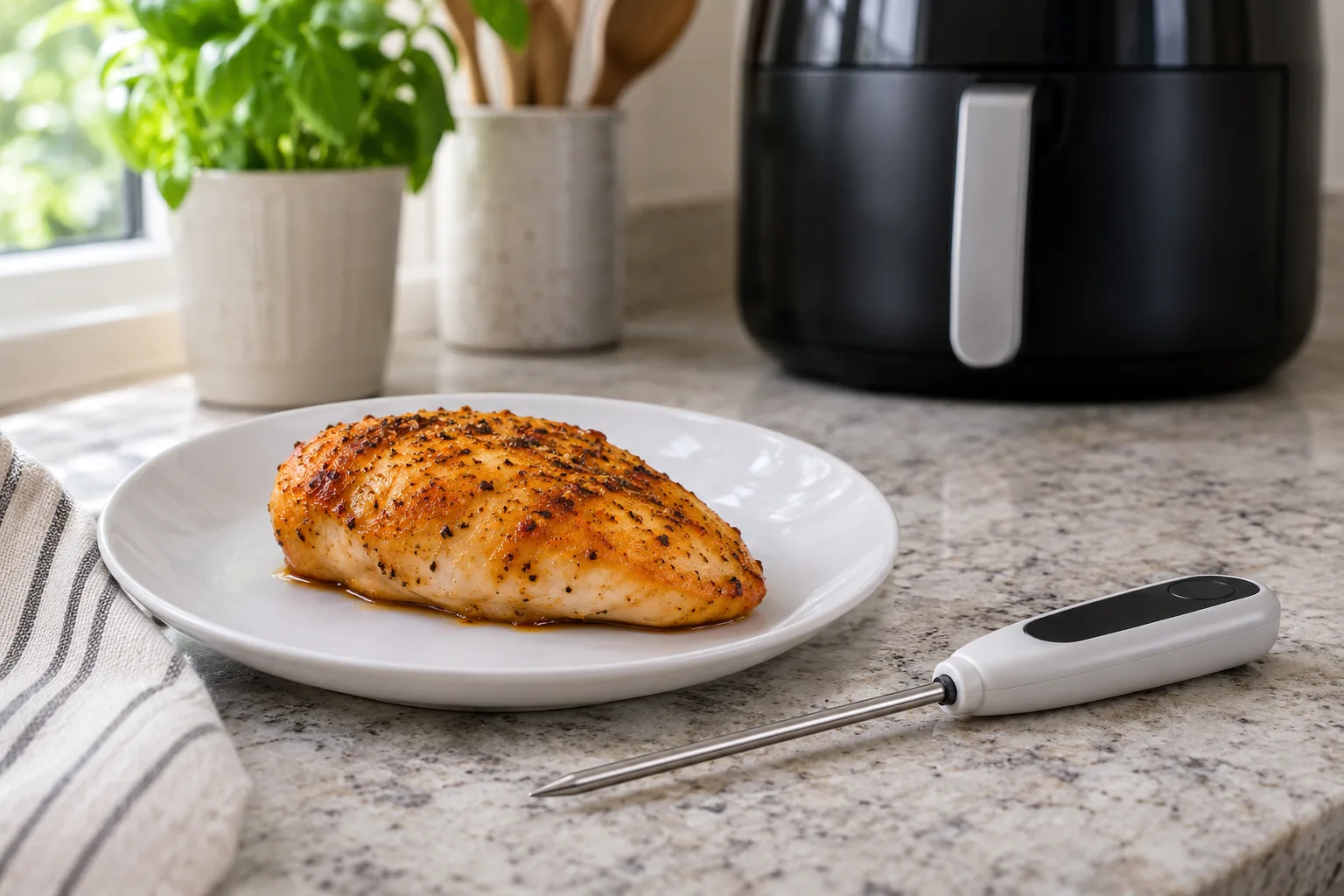
A browned chicken breast can look ready before its centre has finished cooking. The temperature shown on the air fryer is the cooking setting; a food thermometer answers a different question: how hot is the food itself?
Use a clean food probe to check the centre of the thickest part, avoiding bone and the hot basket. For food that needs thorough cooking, UK guidance includes 70°C for two minutes or 75°C for 30 seconds. These are temperature-and-time combinations, not momentary targets. Follow the food instructions and your thermometer manual.
Check what kind of thermometer you own
An instant-read thermometer is for taking a reading during a pause in cooking. Do not leave it inside the running appliance unless its manufacturer explicitly permits that use. A leave-in probe is a different product; both it and the air fryer need to support the arrangement, including any cable routing.
Find the sensing area in the thermometer instructions. ThermoWorks explains that the Thermapen ONE measures at the very tip, but that detail should not be assumed for every probe. Knowing where the sensor sits helps you put it in the food rather than just through the surface.
Put the sensor in the food you want to check
Pause the appliance as its manual directs and make the drawer safe to access. Keep your hand clear of the hot rim. Aim for the centre of the thickest part; avoid touching bone or the crisper plate. With a thin piece, approaching from the side can help keep the sensing area inside the food.
Wait for the reading to settle according to the thermometer instructions. If it changes sharply when you move the probe, check the position again. A reading taken against hot metal is not a useful measurement of the meat.
For a mixed batch, check more than the smallest or most browned piece. Put the probe and a clean resting place for it beside the appliance before cooking so this step is easy to remember.
Use temperature and time together
Government food-safety guidance gives 70°C for two minutes and 75°C for 30 seconds as examples for thorough cooking. Reaching a number briefly does not establish that the corresponding time has elapsed. If a check falls short, continue cooking and check again with a cleaned probe.
Keep following the packet or recipe method. The probe is a check on the result, not a reason to ignore instructions about defrosting, turning or portion size.
For a complete cooking method, see our air fryer chicken breast guide.
Make the next batch easier to judge
Record the food weight or thickness, basket arrangement, cooking setting and the point when you first checked it. Those notes are more useful than writing down a time on its own. They also give you a sensible moment to start checking next time without claiming that every batch will finish identically.
Clean the probe after each use following its care instructions, including after testing food that still needs more cooking. Keep the clean probe separate from utensils used for raw meat.
Air fryers vary in power and basket design. Use these timings as a starting point and follow your manufacturer’s instructions where they differ.
Frequently asked questions
Does a 200°C air-fryer setting mean the food is 200°C?
No. The appliance setting does not measure the centre of the food. Use a suitable food probe for that.
Can I leave an instant-read thermometer in the drawer?
Only if its instructions explicitly allow it. Otherwise remove it before cooking resumes; use supported leave-in equipment if you need continuous monitoring.
Sources and further reading
Safety, appliance and recipe guidance was checked against the following sources. Always follow the instructions for your own model.